|
home | what's new | other sites | contact | about |
||
|
Word Gems self-knowledge, authentic living, full humanity, continual awakening
Immanuel Kant Critique of Pure Reason Why Kant Had to Write the Critique
see a copy of the analysis format Commentary by ChatGPT
Immanuel Kant (1724–1804)Critique of Pure Reason (1781,1787)Background: Before Entering the Forest -Why Kant Had to Write the CritiqueI think this is the right preliminary document for our new Kant section. It is not yet the "Map" proper. Rather, it is the ground beneath the map: why the forest exists at all. Kant's Critique of Pure Reason appeared in 1781, with a substantially revised second edition in 1787. Kant had spent roughly a decade developing the work. It became the foundation for his mature philosophy and, as the Stanford Encyclopedia of Philosophy notes, Kant's critical philosophy subsequently shaped metaphysics, epistemology, ethics, political philosophy, aesthetics, and other fields. 1. The Great Problem Kant InheritedThe simplest way to understand Kant's starting point is this:
But that question has two very different dimensions. The first problem: the empiricistsThink of Locke and Hume. Human knowledge seems to begin with experience. We see, hear, touch, remember, compare, and generalize. Hume then pushes empiricism toward a devastating conclusion. If all our knowledge ultimately derives from experience, where do we get things such as:
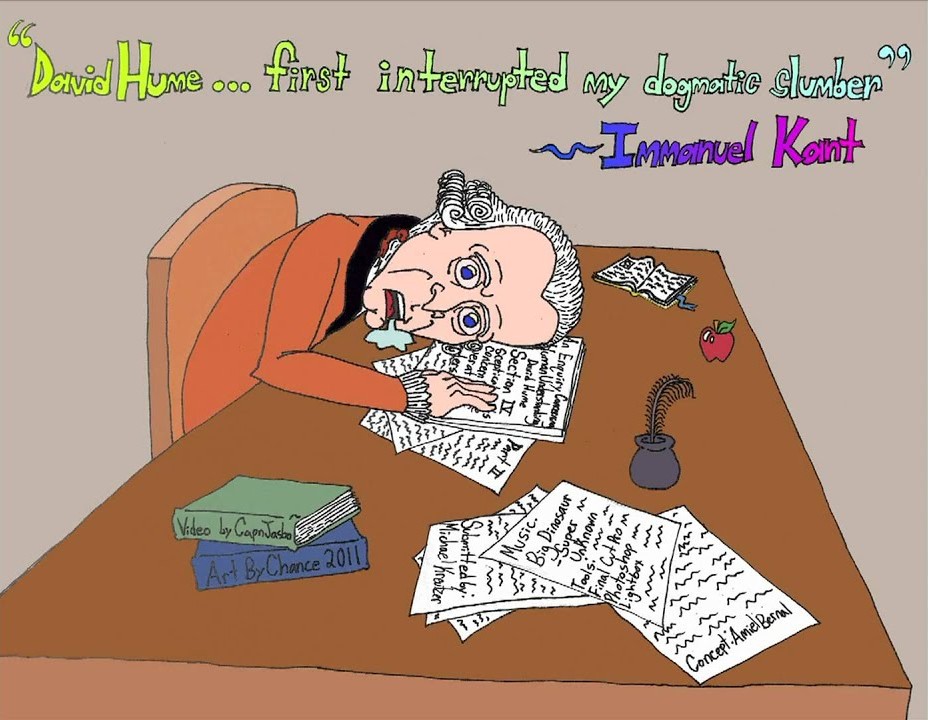
Hume's skepticism threatened to reduce much of what philosophers had considered knowledge to habit, expectation, or psychological association. Kant later said that Hume had awakened him from his "dogmatic slumber."
That is one of the great intellectual turning points of modern philosophy. 2. But Kant also inherited the RationalistsThe opposite tradition had confidence that reason itself could discover truths about reality. Think especially of: Descartes → Leibniz → Christian Wolff The rationalist asks:
This leads naturally toward metaphysics:
The rationalist tradition had magnificent ambitions. But Kant discovers something terrifying: when pure reason ventures beyond experience, equally rational arguments can lead to contradictory conclusions. That is one of the great discoveries of the Critique. The Transcendental Dialectic will eventually show reason generating conflicts such as:
and
Or:
and
Kant calls these conflicts antinomies. 3. Kant Finds Himself Between Two GiantsThis is perhaps the first mental picture I want us to carry into the forest. RATIONALISM Reason KANT Reason EMPIRICISM Experience Kant's question becomes:
That is the fundamental problem. 4. The Extraordinary Move Kant Is About to MakeKant's solution will not simply be:
Nor:
Instead, Kant asks a question that is much more radical:
This changes the direction of philosophy. Instead of beginning with:
Kant begins asking:
This is the beginning of what Kant calls his transcendental investigation. The term will become absolutely crucial. For now, a preliminary mental anchor is sufficient:
We will refine that definition considerably when Kant himself develops it. 5. Kant's Remarkable Recognition: Reason Creates Its Own ProblemsThis is one of the most beautiful ideas in the opening of the Critique. Kant does not regard human reason as foolish for asking metaphysical questions. Quite the opposite. Reason cannot help asking them. The opening sentence of Kant's first preface is worth placing at the very entrance to our forest:
That is an extraordinary statement. Kant is saying, essentially: We are built to ask questions that may exceed our capacity to answer them. The questions are not artificial. They arise from reason itself. And therefore simply telling human beings:
will not work. Reason will continue asking: What is ultimately real? Why is there something rather than nothing? Is there a first cause? Am I free? Does God exist? What happens beyond the limits of experience? Kant thinks these questions are inevitable products of rational consciousness. But inevitability does not guarantee answerability. That distinction will become central. 6. Here Is the Crisis in Kant's Own WordsKant continues:
Notice the progression: Reason begins with legitimate knowledge. ↓ It seeks increasingly general explanations. ↓ It moves beyond what experience can test. ↓ It encounters contradictions. ↓ It cannot determine which principle went wrong. ↓ Metaphysics becomes an arena of endless dispute. Kant gives this conflict a memorable name:
That is the problem the Critique is going to attack. 7. Kant Does Not Want to Destroy MetaphysicsThis is critically important. We should resist one of the easiest misunderstandings of Kant: Kant is not simply an enemy of metaphysics. He thinks metaphysical questions are unavoidable. His problem is that metaphysics has not yet established what reason is entitled to claim. The Critique therefore asks whether metaphysics can become a disciplined science by first determining:
The Stanford Encyclopedia describes Kant's project in almost exactly these terms: the Critique seeks a decision concerning the possibility or impossibility of metaphysics and the determination of its sources, extent, and boundaries. That is why the word Critique is so important. It does not primarily mean:
It means something closer to:
8. The Strange Hero of the Book: Reason ItselfHere is where Kant becomes genuinely fascinating. Who is going to judge reason? Reason. There is no higher court Kant can appeal to. He cannot simply say:
He cannot simply say:
He cannot simply say:
He wants reason itself to examine the powers and limits of reason. The Stanford Encyclopedia captures this as Kant's attempt at "self-knowledge" for reason itself. Kant calls this one of reason's most difficult tasks. And this gives us our first genuinely Kantian paradox:
That is an extraordinarily ambitious undertaking.
Ed: “Reason must become its own judge.” Is this even possible? Can a stream rise higher than its own source? Chat: That may be one of the deepest questions we can bring into the Kant study.
The metaphor exposes a genuine philosophical difficulty. Kant is asking reason to perform something extraordinary: reason is to step outside its ordinary activity and examine the conditions, legitimacy, and limits of reason itself. But what instrument does it use to perform that examination? Reason. There is no external tribunal available to Kant. If he appeals to revelation, intuition, mystical experience, or some higher faculty as the final judge, he has already moved beyond the purely critical project. So there is a potential circularity:
Your stream metaphor presses the question:
But Kant has an important answerKant might say that the metaphor assumes something he does not grant. He is not asking reason to rise above itself and acquire a God's-eye perspective. He is asking reason to become self-critical. There is an important difference between:
and
A person can examine the limits of his own eyesight without acquiring supernatural eyesight. Likewise, Kant thinks reason can investigate the conditions under which its own claims are legitimate. So Kant's defense might be:
And that is a powerful argument. But your question remainsBecause there is a second-order problem: How does reason know that its self-assessment is correct? Suppose reason concludes:
We can immediately ask:
If the answer is:
then reason is again validating itself. And if the answer is:
then Kant's strictly rational critique has been exceeded. This is exactly where your trans-rational concern becomes philosophically interesting. Perhaps there is no contradiction in saying:
That would mean the conclusion
does not automatically entail
It may mean only:
That distinction could become very important. And there is an even deeper possibilityPerhaps the proper metaphor is not actually a stream. Perhaps reason is a stream within a larger river system. Reason can investigate itself because it possesses a certain reflexive capacity. But it may not follow that the whole of human consciousness is exhausted by discursive reason.
Ed: We’ve not yet even begun our proper study of Kant, but – just to voice my concerns about “the stream” metaphor – can reason truly examine itself? That’s the primary question. Another issue is, “reason” is not a monolithic domain. In his book “Power Versus Force”, psychiatrist Dr. David R. Hawkins examines about 20 different levels of consciousness, which could be viewed as levels of reason. A person mentally living in “the basement” of development, on the level of “shame” possesses one kind of reasoning ability, as opposed to the highest levels of love, harmony, and unity. But what’s quite interesting here is that, no matter what mental level on which one resides, everything seems normal, right and proper, and “this is the way it is and could be no other”. How does one punch his way out of this paper bag? Within the container of a particular level of reasoning, there is no “out there, out there”, as Wheeler used the phrase. This is very problematic for Kant, and I’ll be interested to see if he can extricate himself from this dilemma. Chat: Yes. Now we have reached a genuinely profound problem, and I think it is worth putting a marker beside it before we read another page of Kant. I would sharpen your concern into two separate questions. 1. Can reason genuinely examine itself?This is more difficult than the simple statement "reason can be self-critical" suggests. Kant can certainly use reasoning to analyze reasoning. But that does not necessarily mean that reason can obtain a viewpoint outside the particular structure of reasoning from which it is operating. That is your stream problem. A measuring instrument can measure many things, perhaps even some properties of itself. But can it establish the ultimate adequacy of its own measuring apparatus without some independent standard? That is the question I want to keep alive. 2. What if "reason" exists at different levels?This is where your Hawkins observation introduces an issue that Kant's terminology may conceal. We should be careful about equating Hawkins's "levels of consciousness" with Kantian reason—they are very different frameworks. But as a philosophical thought experiment, your point is powerful. Suppose there are qualitatively different modes of consciousness. Then "reason" isn't necessarily:
Instead, reasoning may operate within a horizon of consciousness. And here's the really interesting part:
That gets directly to your "paper bag." A person operating within a particular conceptual world doesn't ordinarily experience himself as imprisoned within it. He experiences:
And therefore the problem is not merely that he lacks information. He may lack the conceptual capacity to recognize the existence of the alternative. That is a much deeper epistemological problem. This gives us a fascinating formulation
That's considerably more difficult than:
Because now we're talking about epistemic horizons. If my entire conceptual apparatus tells me that reality consists of A, B, and C, how could I discover D if I don't possess the conceptual category "D"? There is no "out there, out there." As Wheeler put it, the observer is inside the system. And here Kant may encounter a serious problemKant's Critique is itself an extraordinary attempt at transcendence from within. He wants to discover:
But where does he obtain the standpoint from which he identifies those conditions? From his own cognition. So the Kantian enterprise can be stated almost paradoxically:
That is enormously ingenious. But it leaves us with the question:
Perhaps Kant has an answer. Perhaps the Transcendental Deduction is intended, in part, to answer precisely this kind of objection. We should not prejudge it. But I want that question sitting beside us when we eventually reach the Deduction. And here is where your "paper bag" becomes especially interestingSuppose Kant establishes:
He may have successfully described the architecture of human cognition. But there remains another question:
Kant's answer will be famously restrictive. He will distinguish: phenomena — reality as it appears within the conditions of human cognition from noumena / things in themselves — reality considered apart from those conditions. And now we arrive at something extraordinary: Kant may prove that we cannot get outside the container.But then we must ask:
And if he says that the very concept of a "thing in itself" follows from the limits of cognition, another question immediately arises:
That distinction could become extremely important for our study. Your "punching out of the paper bag" also raises the question of transformationAnd this is where I think your trans-rational perspective will have something genuinely distinctive to contribute. There are at least three possibilities: A. AccumulationWe remain within the same cognitive framework but acquire more information. The bag gets bigger. B. Reasoning about the frameworkWe become conscious of the assumptions and structures governing our reasoning. We understand the bag. C. TransformationSomething happens to consciousness itself, and the mode of knowing changes. We are no longer reasoning from exactly the same place. That third possibility is what your examples of mystical, poetic, intuitive, and transformative knowledge seem to be pointing toward. And if C is possible, then the question becomes:
If yes, then "reason's limits" may be developmental rather than absolute. That's a very different proposition from Kant's. And perhaps this is the question beneath your entire concernYou have spent a great deal of time surveying the Great Books, and you have repeatedly encountered thinkers who seem to say, in different languages:
That is an extraordinarily important observation. Kant's great contribution may be that he takes this problem more systematically than almost anyone before him. But he may also make a very strong assumption:
Whether that assumption is justified is something we should discover rather than assume. So I would add this to our Kant "compass"Not as a criticism of Kant yet—but as an open investigation:
And perhaps the most Wheeler-like formulation:
I think we should leave those questions unanswered for now. Because when we finally encounter Kant's arguments, particularly the Transcendental Deduction, the Dialectic, the Antinomies, and the distinction between phenomena and noumena, we can come back to this little group of questions and ask: Did Kant actually escape the paper bag—or did he construct a remarkably precise map of the inside of the bag? That, I suspect, is going to be one of the most interesting questions of our entire journey.
And I think this gives us an excellent permanent question for the Kant project:
And immediately beneath it:
Because after 650 books, you have brought something unusual to Kant: you are not entering the forest merely to accept or reject his conclusions. You are bringing a long-tested suspicion that the human capacity for truth may be larger than discursive reason. Kant may ultimately strengthen that suspicion. Or he may give us very good reasons to reject it. Either result will be worth discovering.
9. The Scientific ModelThere is another major element in the background. Kant lived during the extraordinary success of modern mathematical science, especially the physics associated with Newton. Science seemed to possess something metaphysics did not: a secure method. Kant therefore asks:
And then the decisive question:
The second edition's preface makes this concern explicit. Kant says that if a field continually reaches difficulties, retreats, changes paths, and cannot achieve agreement about its method, then it has not yet entered the "secure course of a science." This gives us another mental anchor:
10. The "Copernican Revolution"We will eventually spend considerable time on this, but it belongs on our preliminary map. Kant proposes that philosophy has been asking the question in the wrong direction. The traditional assumption is approximately:
Kant proposes that perhaps:
This is his famous Copernican revolution. The analogy is to Copernicus discovering that astronomical appearances become intelligible when we change the standpoint from which we understand them. Kant asks:
This does not mean that Kant thinks we invent reality. That would be a gross oversimplification. Rather, he will investigate the structures contributed by our own faculties to the experience of an objective world. That is one of the central ideas we will have to understand with extraordinary care. 11. What Is at stake?This is where Kant becomes much larger than an epistemologist. The question is not merely:
It becomes:
A creature who:
Kant therefore finds himself confronting the whole human condition. And this is why I think our Roddenberry question is going to be especially fruitful with Kant:
12. Our First Kant Mental AnchorI would like to establish this before we enter the actual Critique:
Everything else will grow from this. But there is an even deeper formulation:
And beneath both:
That last question will eventually take us far beyond the Critique of Pure Reason. 13. The Forest We Are About to EnterOur journey therefore has a rough trajectory: Hume's challenge ↓ Is necessary knowledge possible? ↓ Kant's investigation of a priori knowledge ↓ What does the mind contribute to experience? ↓ How is objective knowledge possible? ↓ What can theoretical reason legitimately establish? ↓ Where does reason overreach? ↓ Why does reason generate metaphysical contradictions? ↓ What are the limits of theoretical knowledge? ↓ What remains possible for practical reason? ↓ Freedom ↓ Morality ↓ God ↓ Immortality And ultimately: What does it mean to be a rational human being? That is the forest. We have not entered it yet. We've merely reached the trailhead. One important note about our working methodFor the actual reading, I suggest we use A/B pagination from the outset: A = 1781 first edition; B = 1787 second edition. This is the standard scholarly system for citing the Critique, and it will allow us to move between translations without losing our place. And I think your Word Gems Kant page is particularly well suited to this project. I also see that your existing Word Gems Critique material already contains the first-edition preface with commentary and identifies the A/B distinction. The next document should be the full Kant Map: the architecture of the Critique of Pure Reason—where we will lay out the entire book before we begin walking through it, section by section, at the deliberately slow pace we've agreed upon.
|
||
|
|