|
Word Gems
self-knowledge, authentic living, full humanity, continual awakening
Experience
Metamorphosis:
The World as Chrysalis of Soul
return to "Experience" main-page
B E S H A R A M A G A Z I N E – I S S U E 3 0 : W I N T E R 2 0 2 5 / 2 6
METAMORPHOSIS: THE WORLD
AS CHRYSALIS OF SOUL
Sabahat Fida contemplates the implications of the caterpillar’s transformation for our understanding of identity
In this timely article, Sabahat Fida discusses contemporary scientific research into the way caterpillars transform into butterflies, and suggests that it gives us a new metaphor for the question of identity. Drawing upon Islamic/Shi‘i cosmology, she maintains that our real identity is located not in the physical realm, but in the intermediate, imaginal world of the barzakh, and for this reason we retain a sense of ourselves even as the soul moves through different layers of existence. Such a perspective gives a different way of looking at the crises we are facing in the world today – not as obstacles but opportunities for transformation.
‘You have been living in a dream world, Neo.’ (Morpheus, The Matrix)

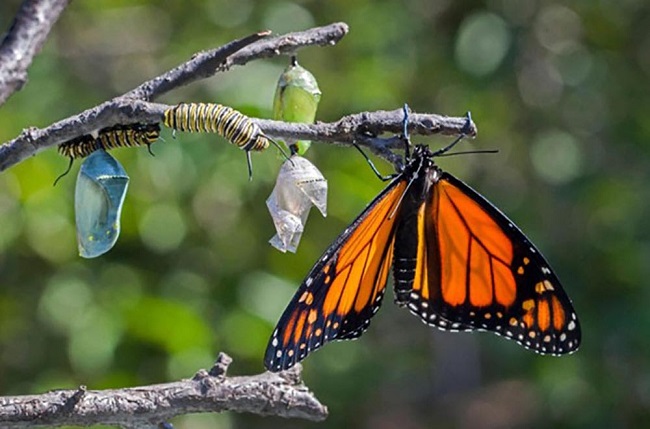
A caterpillar’s transformation is not a simple reconfiguration of parts but a biological event so extraordinary that it continues to unsettle biologists and philosophers alike.
Within the sealed chamber of the chrysalis, the larval body undergoes a process of controlled disassembly: specific enzymes are released, larval tissues lose structural integrity, and much of the organism is reduced to a nutrient-rich suspension.
Amid this dissolution, however, certain clusters of cells known as ‘imaginal discs’ remain intact. These discs, present even in the earliest larval stages, contain the developmental instructions for the adult morphology – wings, antennae, eyes and other structures that have no analogue in the caterpillar.
What complicates the picture further is evidence suggesting that not only structural blueprints but aspects of learned behaviour may survive this radical transformation.
In a series of experiments on Manduca sexta (the tobacco hornworm), researchers conditioned caterpillars to avoid a specific odour by pairing it with a mild aversive stimulus.[1]
Remarkably, when these individuals later emerged as adult moths, many retained the same aversion, despite having passed through a stage in which major neural structures were reorganised or replaced.
Such findings introduce a striking problem: if the organism undergoes near-complete somatic reconfiguration, including the dissolution of much of its nervous system, what mechanism preserves this continuity of memory?
What, if anything, persists as the stable bearer of identity across such profound material interruption?
The metamorphosis of caterpillar into butterfly thus reopens one of the oldest and most persistent questions in metaphysics: what, precisely, constitutes identity across time? Is identity anchored in matter, in the continuity of physical substance? In psychology, in the persistence of memory or consciousness? In an underlying essence or substance, something that remains invariant amid change?
From the pre-Socratic conflict between Heraclitus’s doctrine of perpetual flux and Parmenides’s insistence on the unchanging One to contemporary debates in analytic metaphysics, philosophers have struggled to articulate how an entity can remain itself while undergoing transformation.
The biological case of the caterpillar intensifies this puzzle. If neither matter nor morphology remain continuous, then what grounds the identity of the creature who enters the chrysalis and the one who emerges from it?
Does psychological continuity suffice when its neural basis has been dissolved? Or does the phenomenon point toward a more elusive bearer of identity, one not exhausted by material or functional descriptions?
The chrysalis thus becomes a living problem-space, a site where established categories of identity – material, psychological and substantial – meet their limits.

The Architect Scene in The Matrix where Neo is confronted by a ‘fake reality’ in which the world is trapped. Photograph: Pictorial Press/Alamy Photos
An Islamic Perspective
From within the Islamic metaphysical tradition, one finds a set of conceptual resources that approach the problem of identity from a different perspective.
Rather than grounding persistence in matter or neurobiology, this tradition situates the self within a multilayered ontology in which forms change, but the soul’s ontic address persists.
The Qur’an speaks of the ?alam al-mithal – the imaginal realm – or al-mizan, where souls are gathered, individuated and given their primordial configuration before entering the embodied world. The Qur’an gestures toward this pre-temporal individuation in the verse of the Primordial Covenant,[2] where human souls are summoned in the pre-cosmic realm and addressed collectively – ‘Am I not your Lord?’ – to which they respond: ‘Yes, we bear witness.’
Commentators often interpret this verse as evidence that the soul possesses a determinate identity prior to biological life, an identity not exhausted by later corporeal forms.
Similarly, the Qur’anic notion of the ‘isthmus’ (barzakh) is developed in prophetic literature as an intermediate ontological plane that preserves the soul’s integrity while its perceptual and formal capacities undergo alteration.
In this interpretive horizon, the barzakh functions less as a waiting room and more as a mode of being in which one’s essential self persists through discontinuities of form, not unlike a metaphysical analogue to the chrysalis that both holds and transforms.
Earthly life itself is cast as a transitory passage: Imam ?Ali is reported to have said: ‘People are asleep; when they die, they awaken’ [3] – a remark that uncannily echoes Morpheus’s admonition to Neo in the Hollywood blockbuster The Matrix, framing embodiment as a condition of partial perception rather than full actuality.
Within such a cosmology, the dissolution of bodily structure – as dramatic as the liquefaction of the caterpillar – does not threaten identity, because identity is not reducible to form or matter.
What persists is the soul or self, whose continuity is not biological but ontological, passing through successive states as a single referent.
The chrysalis thus becomes an analogy – imperfect but illuminating – for the soul’s movement across realms: forms dissolve and reconstitute, yet the underlying self remains traceable.
Islamic metaphysics, without claiming to solve the biological puzzle, therefore offers a framework in which radical transformation does not annul identity but reveals its anchoring in a register deeper than material continuity.
Imam ?Ali describes the world as ‘a passing shade’ (?illun za?il) and ‘a shifting abode’ (darun tanqulu ahlaha),[4] while Imam Ja?far al-?adiq (d. 765) likens the soul’s journey to successive unveilings, each rendering previous states as mere approximations of selfhood.
In these accounts, identity persists not because matter or memory remain constant, but because the self is anchored in a continuous ontological trajectory stretching from the pre-cosmic covenant, through embodied life, into the barzakh, and finally the Resurrection.
From this perspective, the dramatic dissolution and reconstitution seen in biological metamorphosis does not jeopardise identity; rather, it provides a natural metaphor for the way the soul shifts through layers of existence while maintaining a single referent across its transformations.

Van Gogh, Green Peacock Moth (1889), from the Butterflies series painted in his final years at an asylum. Van Gogh gazed at butterflies as symbols of hope, likening metamorphosis from caterpillar to butterfly to human growth, resilience and transformation. Photograph: Wikimedia Commons
The Transformation of the World
.In light of these reflections, the transformations of this world – its disruptions, crises and thresholds – appear not as anomalies but as the very architecture through which the soul advances.
Just as the chrysalis represents not a catastrophe but a necessary suspension in which dissolution becomes the precondition for emergence, the human condition unfolds within a world deliberately structured as a site of gradation.
Shi‘i metaphysics consistently presents the everyday world as the arena where souls acquire luminosity or opacity, where latent potentials become actual through encounter, failure, refinement and renewal.
Imam ?Ali describes this life as ‘the field of cultivation for the Hereafter’,[5] suggesting that the apparent fractures and instabilities of worldly existence serve as the soil in which higher capacities take root.
In this reading, crisis is not opposed to spiritual development but is the very medium of it – the friction through which hidden perfections are disclosed.
Thus, the world is neither a finished abode nor a meaningless turbulence; it is a chrysalis-like realm whose purpose is illumination.
The gradations of experience – joy and sorrow, ease and trial, clarity and confusion – form the stages through which the soul prepares for realms where forms are more refined and realities more transparent.
The caterpillar must dissolve to become a butterfly; likewise, the self must pass through states of unmaking and remaking to ascend toward truth.
Crisis, in this metaphysical horizon, is not evidence of abandonment but of design: the world is shaped to transform us, not to spare us from transformation.
Kafka, in his famous novella Metamorphosis, with its atmosphere of resentment, indifference and quiet abandonment, presents transformation as an extinguishing – a movement toward isolation and finality.
By contrast, the metamorphosis envisioned in Shi?i cosmology opens in an entirely different register.
Here, transformation is not a closing but an accession, a gradual blossoming into deeper realities.
Where Kafka’s metamorphosis contracts the self into silence, from this perspective it is understood as the very medium through which the soul unfolds, ascends and comes more fully into what it was created to be.
© Sabahat Fida 2026

Sabahat Fida is an educator based in Kashmir, holding Master’s degrees in Zoology and in Philosophy. Her research and writing operate at the intersection of science, spirituality, metaphysics, and religion with a focus on rendering classical Islamic insights accessible to contemporary thought. Her forthcoming work examines quantum consciousness and Shi‘a eschatology, exploring the nature of the soul and life after death – representing one of the first systematic efforts to bridge modern scientific frameworks with Shi‘a cosmological thought.
|
Editor's last word:
Kafka was a materialist, saw the future as dystopia. As such, his Metamorphosis is presented in shades of grey. Beware of philosophical statements which issue as mere projection of personal distorted outlook. One's metaparadigm influences all ancillary perception.
|
|