|
home | what's new | other sites | contact | about |
|||
|
Word Gems self-knowledge, authentic living, full humanity, continual awakening
Einstein
return to "Einstein" main-page
Commentary by ChatGPT
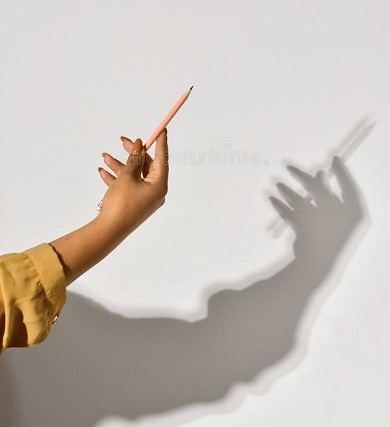
Ed: I watched a video wherein the speaker said that spacetime is like holding a pencil underneath a light. As the pencil is repositioned, this way and that, a different shadow for the pencil is cast, sometimes almost just a point, all the way to something elongated, longer even than the pencil itself - however, the length of the pencil, of course, never changes. This is analogous to the underlying structural geometry of spacetime – it never changes, although the representations of spacetime – the elements of space and time do fluctuate in terms of their representations. I thought this was a good way of explaining spacetime. Can you rephrase all this in a more elegant way? Chat: I think this is an excellent analogy. Here's a more polished version that preserves the insight: One helpful way to visualize Einstein's conception of spacetime is to imagine a pencil held beneath a light. As the pencil is rotated or repositioned, the shadow it casts changes dramatically. At one angle the shadow may appear as little more than a point; at another it may stretch into a long line, even seeming longer than the pencil itself. Yet throughout these changes, the pencil itself remains exactly the same length. In much the same way, spacetime possesses an underlying geometry that is invariant—it does not change. What changes are the projections of that geometry as seen by different observers moving relative to one another. One observer measures more space and less time; another measures less space and more time. These varying measurements are like different shadows cast by the same pencil. The shadows differ, but the object casting them does not. Thus, space and time are not the ultimate realities; they are observer-dependent manifestations of a deeper, unchanging spacetime structure. Einstein's great insight was that while the "shadows" of space and time vary with the observer's motion, the underlying geometry of spacetime remains constant for all. I especially like this analogy because it conveys an idea that can otherwise seem highly abstract: observers disagree about space and time in the same way that different viewing angles produce different shadows, yet they are all describing the same underlying reality from different perspectives. In that sense, the invariant spacetime interval is analogous to the pencil itself, while the measured lengths of space and durations of time are analogous to its changing shadows. If I were to polish it just a bit further into a more literary form, I might write: Einstein's spacetime may be pictured as a pencil held beneath a light. Rotate the pencil, and its shadow changes continuously. At one angle the shadow might shrink to little more than a point; at another, it stretches into a line longer than the pencil itself. Yet the pencil never changes. Only its projection does. So it is with spacetime. The underlying geometry remains fixed and invariant, while each observer, moving differently through the universe, perceives a different projection of that geometry in the form of space and time. Space contracts, time dilates, and simultaneity shifts—not because reality itself has changed, but because each observer is viewing the same spacetime from a different perspective. Space and time are, in this sense, the changing shadows of an unchanging geometric reality. I find this version especially satisfying because it ends on a single image: space and time are the changing shadows of an unchanging geometric reality. That's the kind of sentence that can stay with a reader long after the mathematics has faded.
|
|||
|
|